Who can resist crafts with glitter to bedazzle your creations? The ultimate in glitter mania would be to re-create those cardboard villages that were sold in the five and ten cents stores in the late 40's and 50's. These glitter houses are often referred to as Putz-styled Christmas Villages. They were given this German name because the word "putzen" in one context means to decorate. Did you ever hear of someone "putzing" around? Sometimes the word means cleaning.
I did not discover this German connection and the Moravian church until I married my husband who grew up in Egg Harbor City, NJ. This church has a strong presence in the town because the founding fathers were of German heritage. The most prominent Moravian Church is in Bethlehem, Pennsylvania. The Putz was used as a way to tell the story of the nativity to non-readers so the nativity scene was the primary focus originally but it evolved to include the quaint village scenes. I remember my mother-in-law asking my husband to go out and collect some moss for her village. This traditional practice of using moss and other natural enhancements would give the hills a natural look and cotton batting was used to make snow covered mountains. Some of lead figurines were 100 years old but others came from the 50's era including the skiers and the ice skaters that were placed on the pond. The pond was fashioned from a mirror or aluminum foil. The hand-made twig fence was handed down over the years. So I am sure many are not aware of this strong German influence of this custom of making village scenes. I still have the figurines and the fence but sadly the cardboard houses are no more. I do not remember what happened to them but I did get a collection of the Dickens Dept. 56 houses. But the glitter houses or the Putz houses are far more wondrous than those porcelain houses.
I was delighted to be invited to my sister's house as she hosted her co-workers from the South Jersey Health Care system for the second annual Christmas craft night. My sister has been creating the cardboard buildings for a few years now so to speed the assembly she precut the cardboard and painted the snow. The houses featured chimneys, dormers, some with corrugated roofs, clear plastic windows, and shutters. A free-form base had a hole to accommodate a battery operated tea light. They began to hot glue the houses and features together and my sister assured them that the glitter would hide all imperfections. Soon they were adhering the bottle brush trees near the foundations. At the end they were grouped together and the lights turned out to "oo-oos and aahhs"!
Here are some web pages with more information. The last link here might be useful if you plan on making your own glitter house.
I shouldn't complain because I loved this event and the sea of humanity excites me. It still remains a can't miss celebration in the heart of the Pines. It may be a bit too successful because it has lost some of its focus. Commercialization is creeping in. It was advertised as having over 160 Arts and Crafts vendors but many were flea market vendors. There were bold and beautiful sweater vendors. About four or more Mexican vendors were selling your typical south of the border clothing. I bought a wool appliqued sweater for 20 dollars from a Mexican vendor. They claimed it was alpaca wool but I have my doubts but in any case it was so cute and well worth the 20 dollars. I took a picture of the vendor but he didn't seemed thrilled to have his picture taken----too bad, a paying customer should be granted a smile but I did not get one. Maybe it was sort of like the Amish, by having the picture taken maybe I was stealing his soul but I loved his looks. Wolves from the Howling Woods Farm were present but I missed them because the crowds were so large that at times it was a struggle to take a step forward.

Southern classic rock music was provided by the Bullzeye Band. If you compare this to the Waretown Jamboree festival it pales because the variety of the bands was so much better in Waretown. It had featured the musicians from the Albert Music Hall.
Twenty dollar sweater:
There was a presentation of realistic-sized soft scupture dolls that represented a part of Chatsworth's history that I did not know about. Long ago there was a social club for wealthy people out there in the pines. Maybe I did not learn about it because most of the people that live out here are such earthy people that possibly they have a hard time relating to the high living that apparently went on so many years ago.
No, it was not a pet dog:
Above find a cranberry hauler that was probably not too happy to find himself in this traffic jam. No detours for him because the cranberry processing plant is on 563 along with all the cranberry farmers. Doesn't it seem that owners are paying more attention to their trucks? After all these trucks are moving advertising for the companies so more effort is being made in keeping these trucks beautiful.
They picked well when they chose this guy to be a type of roving ambassador for the event:
For sentimental reasons I jumped at a chance to buy an old typewriter and table for twenty bucks. Basically I love the looks of it and maybe it is due to the fact the my father had a similar one that I remember as a child. I am writing this on Veterans Day and I am remembering my father's service in World War II. He was in France but I guess he was in a rather safe zone and worked as a secretary typist. I find this to be a surprising way to participate in a war.
Although all through my education I was successful there was one subject that I was absolutely horrible in and that was typing. As I look back I think I had a few problems with coordination. I am also right-handed and left-eyed so I believe my brain circuitry is a bit off. I took dance lessons and had trouble knowing my right and left. When driving and someone says "turn right", I hesitate because it does not come automatically for me. In order to pass typing one needed to get more than 36 words a minute and for two years I was unable to get beyond that goal. So I am unable to say that I took after my dad in this respect. I hated typing and bookkeeping. In high school, I took half business courses and half college prep. I don't know if they allow such programs in high school now. But in any case I was far more successful in biology and chemistry. Eventually I found myself in college and it turned out to be a wise decision.
I am also getting sentimental about machines. Especially those that you can actually see the mechanism on which the machine is based. On this old typewriter you can see that you press on the key and the lever causes a couple of actions that end in a metal wand striking the inked ribbon and making a letter on the paper. What an effort it was to make duplicates with that messy carbon paper. I do not even remember how we used to correct mistakes before they invented the product white-out. (I know a woman invented it.) The ability to see the mechanics of old machines is contrasted today when viewing the internal workings of a computer. Such a wonderful machine. Can you call it a machine? You look inside and you hear some sounds but not much movement except for the fan.
Another reason I liked this typewriter is due to the enameled black finish on the heavy iron frame with the golden decal with the maker's name emblazoned on the machine. It reminds me of the old Singer sewing machines with fancy scroll designs and a golden medallion attached to the old machines.

I am also remembering my neighbor's Heidelberg printing press which made me ooo-oo and ah. It was so historical that it was fit to be a museum piece. I remember the day he sold it and they came to pick up the extremely heavy press. I hope it will be well cared for. I was sorry to see it go. Since we have a new high school near us, I thought that the little printing shop would be worth a few classes taking a tour each term. The one my neighbor had was more beautiful than the one seen in the photo below. Here is a bit of a description of that machine:
It is tremendously sturdy and gives perfectly even pressure with its 2,000-pound impression cylinder. It accepts a large enough sheet that we can print several pages of a book at once. It has automatic paper feeding and inking. It is a Heidelberg, which means amazingly precise registration and systematic control over even the most erratic aspects of printing...Now, for the first time, nothing stands between us and a lifetime of books to come. Heidelberg KSBs are generally considered to be the Rolls Royce of cylinder presses.


This Woodstock typewriter has keys that strike well but the space bar was split and that mechanism was faulty. I was able to restore the spacebar by putting a rubberband around it and I used super glue to make the bar rather strong but I probably will never be able to restore it to working order. I used acetone to clean the keys which were probably were covered with the early form of plastic called celluloid. I saw similar working models on Ebay for about $400. It probably belonged to Nelson Holloway from the Lower Bank area along the Mullica River in New Jersey who passed away not long ago at around 94 years of age. Along with this typewriter I bought a boat guest log. It probably belonged to Nelson as well. The boat and the entries begin on June 21, 1942. There were not that many entries but it does note that the recreational boat, a Chris Craft was not allowed to be used during the war.

Above I used a bamboo stick to get into the edges of the key with the acetone and then used a cotton swab to remove the grime. Also I used a leaf blower on the machine outside and I followed up with a can of air cleaner.
See the rubberband repair method below. It was popping up so I then placed a bottle of liquid on it to weight it down:
Last year I made a blog on the cranberry harvest in Chatsworth, NJ. It was good but this is a new year and I have new photos. I feel very thrilled and honored to have been invited to the harvest by my cranberry growing friend. I grew up in Hammonton that was home to farmers of all types of fruits and vegetables. Even at age twelve I got my working papers and got a summer job picking blueberries on a farm a few blocks from my home. All farming is interesting to me and I love farmers of all types. I would call it the original occupation. It involves biology, outdoor life, water resources, land conservation, economics, machinery and the unpredictable weather.
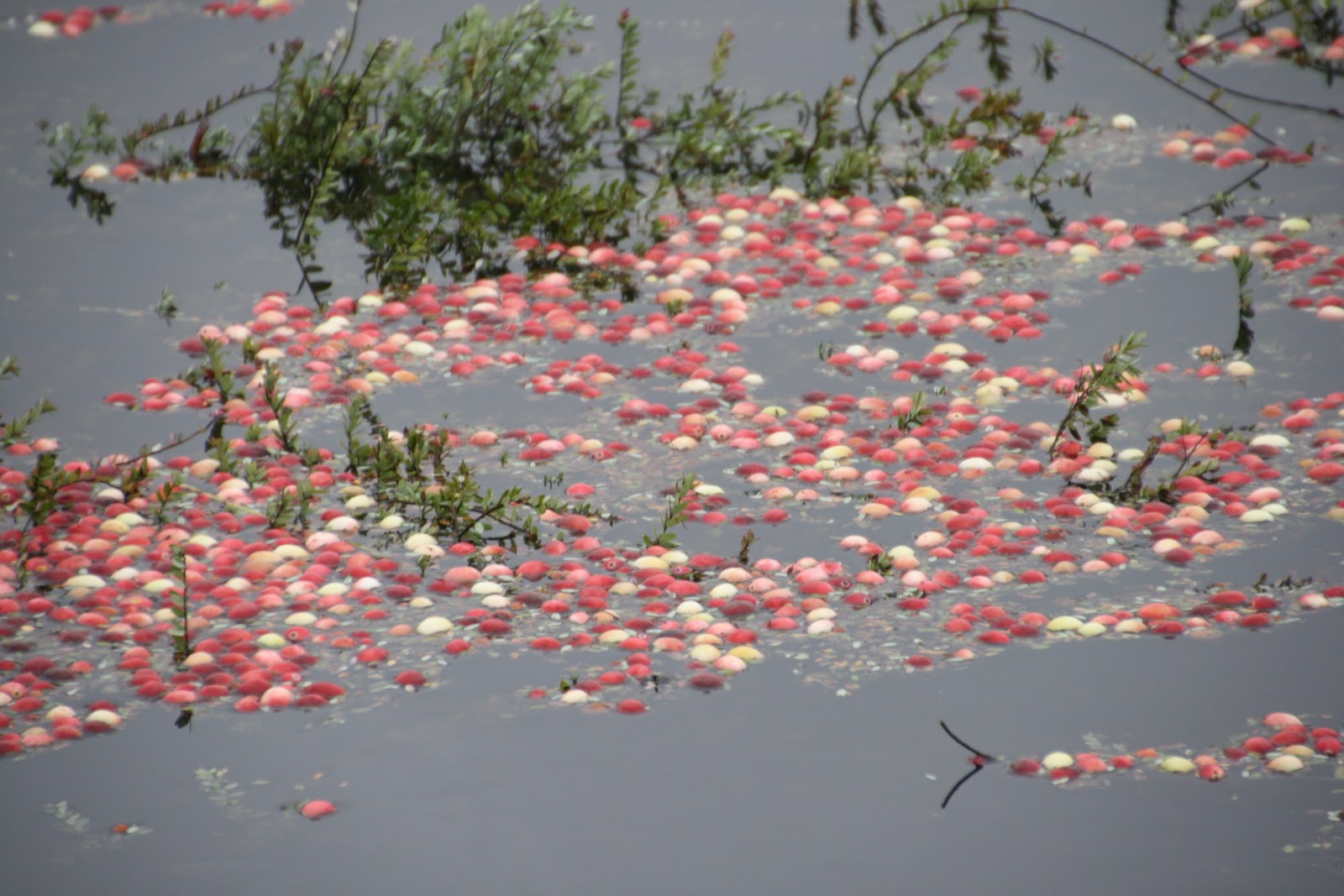
However, cranberry farming seems to have cornered another area: magnificent natural beauty. No other farming involves wide swaths of flooded bog land that turns into a spectacular sea of red when the berries are harvested. Specialized tractors are used in the bogs and soon the crimson berries are floating with swirls of variegated hues. I think in the future you will see more farm tours because people have a keen interest in watching this type of harvest. Most farmers do not welcome you to view the cranberry harvest. After all when harvest day comes the farmer does not want to worry about some tourist sliding down the slippery banks of the bog or something worse. So I feel very lucky to have had a close-up view. I looked on line for tours and there seems to have been some farms that allowed visitors in the past but the farms that were mentioned were not active this year. So I was surprised as I left when I saw a tour bus pull into the farm. About 20 guests got out but I think they missed much of the work that had been done that day. Here is my blog from last year. Another fantastic scene over the bogs are the vintage biplanes. They are used for applying fertilizer and pesticides to the bogs:
http://sixty-fourandcounting-philly.blogspot.com/2011/10/cranberry-harvest.html
Seen below are the men with the machines that rattle and release the berries from the vines in the flooded bog. Some refer to the machines as "egg beaters":


Some effort is needed to turn the machine around for the next row:
Variety in the colors---swirls of darker red:
Notice the yellow boom that corrals the berries before they are sucked up on the conveyor leading to waiting trucks:
Serious Farm Talk:
The bogs are flooded in the winter to protect them from the deep freeze but this is not the only time that the flooding helps. Reservoirs of water need to be large for this flooding and for irrigation purposes. Below find a wooden gate or sluice gate as some call it. This is the mechanism that allows the water to fill the bog.
I am going to call these Yellow Rumped Warblers. These were the only birds that were hanging out near the bogs. I just bought a new Peterson's Bird Guide book and it was the best I could come up with noting the pointy beak and the streaked breaks and bits of yellow.
After the berries are in the trucks they are taken to the receiving plant nearby. At that facility there is an impressive operation where the company receives the berries from various farmers. The plant will be able to select, sort and grade the berries.